NOTE: This is an abbreviated provenance the complete provenance is being formatted to add to page.
AUTHENTICATION AND APPRAISAL
OF ARTWORK
Prepared for
National Fine Arts Title Registration
This document is for the evaluationOF ARTWORK
Prepared for
National Fine Arts Title Registration
of the subject work of art for
marketing and insurance purposes
SUBJECT SCULPTURE

ARTIST: David Jakupca (American, 1951 - )
TITLE: Worlds Children Peace Monument (WCPM) aka “Peace Carved in Stone”
DATE: 2002
DESCRIPTION: Stone Sculpture, 2002, W 45in x H 49in x D 7in Weight: 1280 Lbs Roughly square shaped with white dove engraved on both sides.
CONDITION: In excellent condition
TITLE: Worlds Children Peace Monument (WCPM) aka “Peace Carved in Stone”
DATE: 2002
DESCRIPTION: Stone Sculpture, 2002, W 45in x H 49in x D 7in Weight: 1280 Lbs Roughly square shaped with white dove engraved on both sides.
CONDITION: In excellent condition
Subject Sculpture Summary
The
Worlds Children Peace Monument is an original sculpture conceived
during EXPO 2000, the Worlds Fair held in Hannover, Germany by American
Cultural Ambassadors David and Renate Jakupca. It was designed and
built by David Jakupca at the historic ARK in Berea as a project of the
International Center for Environmental Arts (ICEA) in cooperation with
the United Nations 2000 Culture of Peace Program. The WCPM was
organized in support of the UN Decade of Peace and Non-Violence for the
Children of the World and the United Nations Millennium Development
Goals.
The
WCPM was officially inaugurated in 2005 at the 3rd World Peace
Conference held in Verbania, Italy where it received an Italian Medal
of Arts Award. It was debuted at its present location during the 2003
Berea Arts Fest. The WCPM Project is to encourage positive community
participation through the establishment of international site-specific
works of public art, through cultural education and entrepreneurial
training to children around the World.
The WCPM Appraisal is another step forward to naturalizing ‘Great American Peace Trail’, the coast-to-coast trail of WCPM Peace Stones in city parks designed to stop the violence in America’s youth. The WCPM Appraisal also serves as a milestone for the 'Theory of Iceality on Environmental Arts' and that is, promoting a sustainable global Culture of Peace for all Living Things. North East Ohio Area has been 'branded' as the Home of the Environmental Art Movement by the International Center for Environmental Arts (ICEA) as a 'Cultural Industry' to foster civic identity, cultivate tourism, and brand Ohio Environmental Arts and Culture in the Bioregion.
The WCPM Appraisal is another step forward to naturalizing ‘Great American Peace Trail’, the coast-to-coast trail of WCPM Peace Stones in city parks designed to stop the violence in America’s youth. The WCPM Appraisal also serves as a milestone for the 'Theory of Iceality on Environmental Arts' and that is, promoting a sustainable global Culture of Peace for all Living Things. North East Ohio Area has been 'branded' as the Home of the Environmental Art Movement by the International Center for Environmental Arts (ICEA) as a 'Cultural Industry' to foster civic identity, cultivate tourism, and brand Ohio Environmental Arts and Culture in the Bioregion.
ABOUT:
David Jakupca, is an American Philosopher, Ambassador, Artist,
Activists and Author. He serves both as American Cultural Ambassador
and Universal Peace Ambassador in International capacities. He is
extremely influential through his works, especially as philosophical
advocate and practitioner of the environmental arts methods developing
the Sustainable Age revolution. Jakupca is
the 'Spiritual Father of the Environmental Art’ Movement and is the
co-creator with his wife Renate of the 'Theory of Iceality on
Environmental Arts'. His works established and popularized inductive
formula's for scientific inquiry, sometimes called the Iceality Method. His
demand for a planned procedure of investigating all things natural
marked a new turn in the rhetorical and theoretical framework for the
science of aesthetics, much of which surrounds conceptions of proper
Environmental Art Methodology today.
APPRAISAL NOTES
1. This appraisal is
submitted, using public images and information and material supplied by
the Artist, along with direct inspection of the subject sculpture.
2. The work of David Jakupca appears regularly in the international art marketplace through exhibitions and private sales. This evaluation of the subject sculpture is made primarily from its relationship to similar works in public and private collections. The findings for these historical results for the artist are listed in Appendix “A”, and Standard Biographical References and Resources used in appraisals are listed in Appendix “B” of this report.
3. Specific comparable images of paintings and sculptures by Jakupca, chosen from those researched in Appendix "A", are included in this report for the reasons of, first, similarities; second, artwork specifically contrasted with the subject sculpture to show the different color and style relationships typical of the artist; and third, to show how value is affected by positive public popularity.
4. There are no significant breaks in Jakupca’s professional career, which span from 1977 to present.
5. Size is also a factor in the artist's work. Of course, with all other aspects being equal, the larger sizes bring higher prices in the marketplace. The large size of the subject sculpture is a plus factor for its value.
6. The orderly composition of the subject sculpture is unusual for the artist, but the execution leaves plenty of room for conjecture. Also, the manner in which the Dove is positioned in the center of the stone, with no real background or foreground showing, is unusual.
7. The drama for the subject sculpture is created mostly in the fact that this is monumental. The color is naturally strong, but expected with the chosen type of work. The sculpture, having strong red rock color and a white dove, has a very dramatic contrast, and it is effective in producing its intended result of having real authority and longevity. The overall effect is striking and this work must be considered a major effort by the artist.
8. Provenance of the subject sculpture places its conception at Germany's World's Fair, EXPO 2000's 'Culture on the Move' segment. American Cultural Ambassadors David and Renate Jakupca addressed the 140 Nation Assembly of the concept for a permanent universal symbol of renewal and peace on earth for all living inhabitants through the 'Theory of Iceality on Environmental Arts'. This Symbol of Living Peace was the subject sculpture. This project was initiated in cooperation with the United Nations 2000 Culture of Peace Program and organized in support of the UN Decade of Peace and Non-Violence for the Children of the World and the United Nations Millennium Development Goals.
9. Construction of the subject sculpture dates back to the ARK in Berea. Support for its dates of execution of 2001 - 2002 have been provided by supportive dated public material, photographs, as well as by neighbors of the site, who have recalled the sculpture as far back as 2001.
10. The original placement for the subject sculpture was the Cleveland Cultural Gardens but political barriers ended the idea. The subject sculpture debuted during the 2003 Berea Arts Fest at its current location on the north bank of Coe Lake Park in Berea, Ohio. The condition of the sculpture is excellent, indicating good care and conservation.
11. The subject sculpture was officially inaugurated by American Cultural Ambassadors David and Renate Jakupca in June 3-5, 2005 at the 3rd World Peace Conference held in Verbania, Italy.
12. For reasons unknown, in 2009, the City of Berea has illegally placed a cement pad and park bench in front of the subject sculpture in such a position as to block the public view of the artwork and overall destroy the message of peace.and tranquility it was meant to convey.
2. The work of David Jakupca appears regularly in the international art marketplace through exhibitions and private sales. This evaluation of the subject sculpture is made primarily from its relationship to similar works in public and private collections. The findings for these historical results for the artist are listed in Appendix “A”, and Standard Biographical References and Resources used in appraisals are listed in Appendix “B” of this report.
3. Specific comparable images of paintings and sculptures by Jakupca, chosen from those researched in Appendix "A", are included in this report for the reasons of, first, similarities; second, artwork specifically contrasted with the subject sculpture to show the different color and style relationships typical of the artist; and third, to show how value is affected by positive public popularity.
4. There are no significant breaks in Jakupca’s professional career, which span from 1977 to present.
5. Size is also a factor in the artist's work. Of course, with all other aspects being equal, the larger sizes bring higher prices in the marketplace. The large size of the subject sculpture is a plus factor for its value.
6. The orderly composition of the subject sculpture is unusual for the artist, but the execution leaves plenty of room for conjecture. Also, the manner in which the Dove is positioned in the center of the stone, with no real background or foreground showing, is unusual.
7. The drama for the subject sculpture is created mostly in the fact that this is monumental. The color is naturally strong, but expected with the chosen type of work. The sculpture, having strong red rock color and a white dove, has a very dramatic contrast, and it is effective in producing its intended result of having real authority and longevity. The overall effect is striking and this work must be considered a major effort by the artist.
8. Provenance of the subject sculpture places its conception at Germany's World's Fair, EXPO 2000's 'Culture on the Move' segment. American Cultural Ambassadors David and Renate Jakupca addressed the 140 Nation Assembly of the concept for a permanent universal symbol of renewal and peace on earth for all living inhabitants through the 'Theory of Iceality on Environmental Arts'. This Symbol of Living Peace was the subject sculpture. This project was initiated in cooperation with the United Nations 2000 Culture of Peace Program and organized in support of the UN Decade of Peace and Non-Violence for the Children of the World and the United Nations Millennium Development Goals.
9. Construction of the subject sculpture dates back to the ARK in Berea. Support for its dates of execution of 2001 - 2002 have been provided by supportive dated public material, photographs, as well as by neighbors of the site, who have recalled the sculpture as far back as 2001.
10. The original placement for the subject sculpture was the Cleveland Cultural Gardens but political barriers ended the idea. The subject sculpture debuted during the 2003 Berea Arts Fest at its current location on the north bank of Coe Lake Park in Berea, Ohio. The condition of the sculpture is excellent, indicating good care and conservation.
11. The subject sculpture was officially inaugurated by American Cultural Ambassadors David and Renate Jakupca in June 3-5, 2005 at the 3rd World Peace Conference held in Verbania, Italy.
12. For reasons unknown, in 2009, the City of Berea has illegally placed a cement pad and park bench in front of the subject sculpture in such a position as to block the public view of the artwork and overall destroy the message of peace.and tranquility it was meant to convey.
CONCLUSION
The
subject sculpture is a major work by David Jakupca, both in size and
scope of the composition. The solidarity in composition of the
sculpture as well as the unusual nature of the sculpture’s mission are
mitigating factors to its value. The provenance of the sculpture is
compelling and there is no reason to doubt its authenticity. The
sculpture, after having stood outdoors for ten years, is well cared for
and is in good condition, attesting to its strong constitution and craftsmanship, adding to its desirability.
EVALUATION OF THE SUBJECT ARTWORK:
David Jakupca: Worlds Children Peace Monument $2,400,000 USD
 -----------------------------------------------------------------------------------
Appendix "A"
 -----------------------------------------------------------------------------------
Appendix "A"
RESEARCH FINDINGS
Results for Comparable Artworks and Artist History of David Jakupca
Results for Comparable Artworks and Artist History of David Jakupca
David Jakupca is an American Philosopher, Ambassador, Artist, Activist and Author. He serves both as an American Cultural Ambassador and Universal Peace Ambassador in International capacities. He is extremely influential through his works, especially as a philosophical advocate and practitioner of the environmental arts methods developing the Sustainable Age revolution.
Jakupca with his wife, Renate, are the co-creators of the 'Theory of Iceality on Environmental Arts', aligning the vision with real-world social conditions and logistics. This work established and popularized inductive formulas for scientific inquiry, sometimes called the Iceality Method. His demand for a planned procedure of investigating all things natural marked a new turn in the rhetorical and theoretical framework for the science of aesthetics, much of which surrounds conceptions of proper Environmental Art Methodology today.
Jakupca has been recognized as the 'Spiritual Father of the Environmental Arts Movement' and in that capacity, several disciples of his work went on to spread the word on Iceality. His ideas were influential in the 1990's among scholars like Jane Alexander, Chairwoman of the National Endowment of the Arts (NEA), who in the ‘AMERICAN CANVAS’ Project frequently adheres to the Method of Iceality approach in its idealistic visions and entrepreneurial inquiries. Major organizations, in particular, the United Nations, featured his Theory on Iceality in many of their World Conferences. The result of this major global public promotion at the United Nations level is that the Theory of Iceality on Environmental Arts is now considered as the cornerstone of the modern sustainable global Environmental Art Movement, and this concept is now replicated by artists, architects, urban planners and sustainable organizations throughout the World, reflecting a still growing global audience. However, it must be noted that not all of Jakupca's contemporaries did accept the new theory at once.
David Jakupca is also considered to be the philosophical influence behind the dawning of the millenniums Sustainable Age. In his works, David Jakupca called for a development of avant-garde trilateral symmetry of social systems to align his vision with real-world social conditions and logistics that contend with the problems facing earth’s future. He always proposed that these environment/humanitarian/cultural systems should be done in conjunction with charitable purposes as a matter of healing this planet. Recalling Einstein’s admonition, paraphrased here, that a problem cannot be solved by the same thinking that created the problem in the first place, Jakupca, being ever mindful of the ecospheric integrity, advocated that the Environmental Arts should be practical and have as a holistic purpose the improvement of all living things.
This changed the course of art in history, from a merely contemplative state, as it was found in ancient times, to a practical, inventive modern state that will, it time, continue to lead to the new Methods of Iceality that will prevent Ecocide and make possible a Sustainable Age, a Culture of Peace for all Living Things in the following centuries.
Although much of these Methods of Iceality proposals will not be established in his lifetime, his legacy was already considered by TIME Magazine, in their 2000 Millennium Edition, as one of their Heroes of the Planet. Similar to a Cultural District with the historic ARK in Berea as its focal point, the North East Ohio Area where David worked, has been 'branded' as the Home of the Environmental Art(s) Movement by the International Center for Environmental Arts (ICEA) and as 'Cultural Industry' will continue to foster civic identity, cultivate tourism, and brand Ohio Environmental Arts and Culture in the Bioregion.
For as one of his profilers, India Keyes commented, Jakupca's influence in the future world is so important that every person, plant or animal well being may be traced back to him. It is possible that someone using the Methodology of Iceality may find the cause of cancer, solve the worlds hunger problem or eliminate global warming.
David Jakupca’s philosophy in Art is displayed in his vast and varied art works and writings, which might be divided into the three great branches of the 'Theory of Iceality on Environmental Arts':
~ Environmental works – in which his ideas for a universal reform of knowledge, scientific method and the improvement of a sustainable state of Peace for all living things is presented.
~ Humanitarian works – in which his reforms in moral philosophy and social practices for Mankind are proposed.
~ Artistic works – in which he presents his original applied aesthetics on art and cultural objet d’arts.

The Minstrel Boy
Acrylic on Canvas 30" x 40" 1981 Signed Lower Left
Bermuda Maritime Museum
Acrylic on Canvas 30" x 40" 1981 Signed Lower Left
Bermuda Maritime Museum

The Controllers
Acrylic on Canvas 30" x 46" 1979 Signed Lower Right
McKinley Museum
Acrylic on Canvas 30" x 46" 1979 Signed Lower Right
McKinley Museum

United Steel Workers of America
Mixed Media 2002 Unsigned
David Jakupca, through ICEA, has donated signs, murals, paintings, press releases, etc. for organizations, causes, and people worldwide. This is especially true for Third World Countries at the UN World Conferences.
Mixed Media 2002 Unsigned
David Jakupca, through ICEA, has donated signs, murals, paintings, press releases, etc. for organizations, causes, and people worldwide. This is especially true for Third World Countries at the UN World Conferences.


ARK in Berea
Mixed Media 1994 Signed Middle Front
A.R.K. stands for - Architektur Recycled Kulturstall.
The historic A.R.K. in Berea is the first structure in Cuyahoga County,
Ohio to incorporate sustainable building concepts from the Earth Summit
in Rio de Janeiro in 1992. It was hand built in 1994 by David and
Renate Jakupca and considered the global home of the Environmental Arts
Movement.
Estimated replacement value at $119,000 by the Cuyahoga County Auditor's
Office, its value goes up exponentially when its historical, social and
environmental factors are added in.

People Not Mascots' Logo
Acrylic on Canvas 22" x 28" 1992 Signed Lower Right
Current Owner assumed to be Lake Erie Native American Council (LENAC)
The 'People Not Mascots' Logo is a Native American protest caricature of the Cleveland Indians Baseball team. It was originally painted by David Jakupca it has drawn criticism from some sportswriters, fans and local businessmen, but gained immediate acceptance among religious groups, and Native Americans. It gained international popular attention when it was it exhibited by ICEA at the 1993 UN World Conference on Human Rights held in Vienna, Austria and has become one of the most recognized anti-racists logo's in existence. It also caused repercussions for the groups connected with the logo and this has been documented in the INTERNECINE MATRIX http://theicea.com/page21
Awards and Citations
Acrylic on Canvas 22" x 28" 1992 Signed Lower Right
Current Owner assumed to be Lake Erie Native American Council (LENAC)
The 'People Not Mascots' Logo is a Native American protest caricature of the Cleveland Indians Baseball team. It was originally painted by David Jakupca it has drawn criticism from some sportswriters, fans and local businessmen, but gained immediate acceptance among religious groups, and Native Americans. It gained international popular attention when it was it exhibited by ICEA at the 1993 UN World Conference on Human Rights held in Vienna, Austria and has become one of the most recognized anti-racists logo's in existence. It also caused repercussions for the groups connected with the logo and this has been documented in the INTERNECINE MATRIX http://theicea.com/page21
Awards and Citations
coming soon
----------------------------------------------------------------------------------
Appendix "B"
REFERENCES AND RESOURCES
Standard Biographical References and Resources used in research and appraisals are:
Standard Biographical References and Resources used in research and appraisals are:
Davenport: Davenport¹s Art Reference and Price Guide by R.J. Davenport, published yearly, 1987 to present.
Franklin & James: Auction Price Guide, published Bi-Annually
Falk¹s: Auction Price Guide, published Annually
Hislop¹s Art Price Index: Auction Price Guide, published Annually
Meyer¹s Price Guide to Antiques and Fine Art: Auction Price Guide, published Bi-Annually
Fine Art: (Susan Theran) Auction Price Guide to the Art Marketplace, published Bi-annually from 1987 to 1996
Art at Auction in America: Auction Price Guide, published Annually from circa 1990 to 1995
AskArt: Online auction, gallery and research resource on the internet
ArtNet: Online auction, gallery and research resource on the internet
Fine Art Investment Services: Online auction, gallery and research resource on the internet
ADEC (Artprice): Online auction, gallery and research resource on the internet
Art Library Online: Online auction, gallery and research resource on the internet
Traditional Fine Arts Online: Online auction, gallery and research resource on the internet
iCollector: Online auction, gallery and research resource on the internet
The United States Library of Congress: in Washington, DC
American Art Review: A bi-monthly art magazine devoted to the art marketplace and museum and gallery operations
Art and Auction: A bi-monthly art magazine devoted to the art marketplace and art auction operations
Art and Antiques: A bi-monthly art magazine devoted to the art marketplace and art and antiques auctions
Antiques: A monthly art magazine devoted to the art and antiques marketplace and gallery operations
American Artist: A monthly art magazine devoted to the art marketplace and artist promotions and marketing.
The Artist: A monthly art magazine devoted to the art marketplace and artist promotions and marketing.
Franklin & James: Auction Price Guide, published Bi-Annually
Falk¹s: Auction Price Guide, published Annually
Hislop¹s Art Price Index: Auction Price Guide, published Annually
Meyer¹s Price Guide to Antiques and Fine Art: Auction Price Guide, published Bi-Annually
Fine Art: (Susan Theran) Auction Price Guide to the Art Marketplace, published Bi-annually from 1987 to 1996
Art at Auction in America: Auction Price Guide, published Annually from circa 1990 to 1995
AskArt: Online auction, gallery and research resource on the internet
ArtNet: Online auction, gallery and research resource on the internet
Fine Art Investment Services: Online auction, gallery and research resource on the internet
ADEC (Artprice): Online auction, gallery and research resource on the internet
Art Library Online: Online auction, gallery and research resource on the internet
Traditional Fine Arts Online: Online auction, gallery and research resource on the internet
iCollector: Online auction, gallery and research resource on the internet
The United States Library of Congress: in Washington, DC
American Art Review: A bi-monthly art magazine devoted to the art marketplace and museum and gallery operations
Art and Auction: A bi-monthly art magazine devoted to the art marketplace and art auction operations
Art and Antiques: A bi-monthly art magazine devoted to the art marketplace and art and antiques auctions
Antiques: A monthly art magazine devoted to the art and antiques marketplace and gallery operations
American Artist: A monthly art magazine devoted to the art marketplace and artist promotions and marketing.
The Artist: A monthly art magazine devoted to the art marketplace and artist promotions and marketing.
This appraisal is executed for National Fine Arts Title Registration for the subject work,
Worlds Children Peace Monument.
I certify that the information contained in this appraisal has been thoroughly researched and is a true,
accurate and complete record of my findings.
The format of this appraisal has been adjusted so as to conform with the
UNIFORM STANDARDS OF PROFESSIONAL APPRAISAL PRACTICE (US PAP).
Certified on this Day
July 6, 2013
Patrick Cahill (Seal)
_____________________
Bonnie and Cahill
Certified Public Accountants
535 Front St
Berea, Ohio 44017
216-832-6808
Moments in Peace 2007
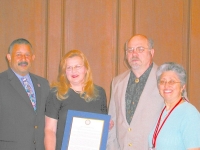
l to r: Councilman Santiago, Renate,
l to r: Cleveland Councilman Joe Santiago, Renate,
David Jakupca, Sister Alicia Keyes
Cleveland City Councilman Joe Santiago honors American Cultural Ambassadors David and Renate Jakupca of the International Center for Environmental Arts (ICEA) on the occasion of the World Peace Conference by installing the Santa Fe Peace Stone of the Worlds Children Peace Monument (WCPM). .
ARK in Berea - The purpose of the
worldwide movement, 2007 World Peace Conference - "Building a Culture
of Peace" in Santa Fe, New Mexico, was to envision solution, use
proactive public diplomacy to communicate more effectively with the
rest of the world and build understanding for its values and policies
and create a program for World Peace Between Nations and Nonviolence in
Our Homes and Our Community.
With the support of New Mexico Governor Bill Richardson and the
leadership of Ms. Louise Diamond, PhD, Jody Williams, the winner of
1997 Nobel Peace Prize, and Arun Gandi, grandson of Mahatma Gandi, and a
host of others, made Santa Fe, New Mexico a focal point in America for
international hope and peace-inspiring events during the time when
wars are raging on almost every continent around the world.
In conclusion of their 20th year of promoting ICEAlity, the
understanding of the relationship between Humans and their Environment
through the Arts", Universal Cultural Peace Ambassadors David and
Renate Jakupca dedicated to the Peace Garden at the Santa Fe Children's
Museum, the Santa Fe Stone of the Worlds Children Peace Monument
(WCPM).
Designed at the ARK in Berea and built at Coe Lake Park in Berea,
Ohio, the Worlds Children Peace Monument (WCPM) was officially
inaugurated in 2003 at the 3rd World Peace Conference held in Verbania,
Italy by American Cultural Ambassadors David and Renate Jakupca, where
they received an Italian Medal of Arts. They were also recognized by
the United Nations in Geneva, Switzerland and in 2006 appointed
Universal Peace Ambassadors. The WCPM is organized in support of the UN
Decade of Peace and Non-Violence for the Children of the World and the
UN Millennium Development Goals.
"The European American community is very proud of ICEA achievements.
And I hope, our pride will show with our continuing support for this
organization". states Zenon A. Domanski, Editor and Publisher of KOLORS
Magazine.
At the formation of ICEA, Canadian activist Rick Coronado from Great
Lakes United forecasted, " The International Center for Environmental
Arts (ICEA) David and Renate Jakupca will act as our benchmark by which
we can measure change and continuity in everything from the
environment to relations between peoples through the Arts. But more
than that, it will remind us that we are not the first People, native
and newcomers alike to face difficult choices in troubled times". The
winds of change blew as hard then as now.
When honestly told, the David and Renate story inspires without
leading us into simpleminded platitudes. History humanizes us by giving
names, faces and texture to our physical and cultural landscapes. Not
only do the Jakupca exhibits entertain us, they serve as a map and guide
for life on the road of a sustainable global Culture of Peace for all Living Things.





