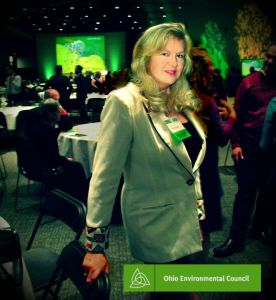
Ambassador Renate ~ First Lady of Peace
Renate Jakupca of the Siebenbuergen
Saxons along with her husband David Jakupca in 1987 created a
revolutionary method for making a sustainable culture of Peace for All
the Worlds Children and establishing a whole new scientific field in
Environmental Arts and Culture.
Her pioneering work on Peace through the
‘Theory of Iceality on Environmental Arts’ has had a significant impact
on future peace endeavors and research. A risk-taker, Ambassador Renate
has always done things her way: Committed to preserving our planet, she
has dedicated her life to finding new and intelligent solutions to
address the environmental challenge.
Passionate and determined, she is
convinced that education for all is the key to a better peaceful world
and, through her work at the International Center for Environmental Arts
(ICEA), she hopes to contribute to promoting Sustainable Global Peace
as a Science for a captivating and fun career path for all the Worlds
Children.
“…..Nach dem Staatsstreich vom 23 August
1944 und der Kriegserklarung Rumaniens am Deutschland zwei Tage spatter
spitzte sich die Sicherheitslage Anfang September fur einige sachsische
Gemainden im sogenannten Szeklerzipfel bzw. im ungarisch-rumanischen
Grenzraum bedrohlich zu. Als deren unmittelbare Folge kam es fur
Tausende von alteren Menschen, Frauen und Kindern zure ubersturzten
Flucht, die fur einige den Tod, fur die moisten Not, Elend und
Heimatverlust mit sich brachte. Im Folgenden soll die Chronologie der
militarischen Ereignizze in diesen dramatischen Spatsommertagen
nachgezeichnet warden”.
ARK in Berea: “…..Only two days after the coup of 23 August 1944 and the declaration of war on Germany,
the security situation beginning in September became threatening for some Saxon Communities in the so-called Székely tip or in the Hungarian Romanian border region.
The direct result of the coup was death for some people, but for most
poverty, misery and loss of home for some tens of thousands of older
people, women and children.
This is the beginning of the chronology of the military events that started on that dramatic late summer day. When
Romania signed a peace treaty with the Soviets in 1944, the German
military began withdrawing the Saxons from Transylvania: Around 100,000
Germans fled before the Soviet Red Army, but Romania did not conduct the
expulsion of Germans as did neighboring countries at war’s end.
However, more than 10 Million people including 70,000 Transylvania
Saxons ‘disappeared’ after they were arrested by the Soviet Army for
alleged cooperation with Germany”.

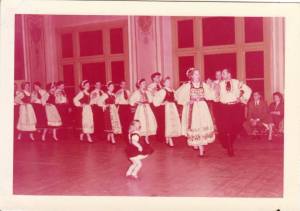
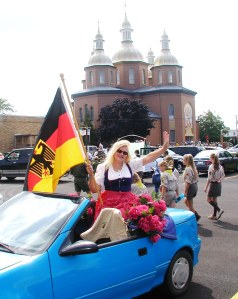
1956 Saxon Dance Troupe with Renate Gottschick
Because they were considered Auslandsdeutsche (“Germans abroad”) by the
German government, the Saxons had the right to German citizenship.
Consequently, numerous Saxons emigrated to Germany and Austria. Renate’s
Father, Hans Gottschick, who was born in Waltersdorf, was drafted into
the German Army and became a POW in Linz, Austria. After he was was
discharge, moved to Ried in Immkreis, Austria where Renate was born. The
Gottschick Family later emigrated from Austria to Ohio City in
Cleveland, Ohio where many of the German/Saxon immigrants congregated.
They all lived in an apartment building near the Westside Market until
permanent housing and jobs could be found. Across the street from the
apartment was St. Emeric Hungarian Catholic Church. In those years,
shopping at the Westside Market was pretty much of a daily ritual. There
were no big malls. Fries and Schuele was also a store which was visited
frequently. It was not easy in those years coming to a new country and
life, but there was a bond and togetherness with the German community
that is still talked about today. Families in the The Greater Cleveland
German community still support each other to this day. Friendships were
always cherished amongst the communities. When Renate was very young,
going to the Westside Sachsenheim was always special.
There were holiday
events for children which we always looked forward to. To this day,
these events are still going on at the Sachsenheim. Renate met her
husband, David, at the Sachsenheim when his family help start the
Deutshe Musik Verein (German Music School). Renate is an active Member
of Branch 4 of the Alliance of Transylvania Saxons. Sachsenheim is a
very special historical place with many memories for them and other
people, too. They also remember going to the Hofbrau Haus (which was the
Eastside Sachsenheim) on East 55th Street which would have dances every
Friday and Saturday nights. You would always see the ethnic community
there on those nights! Steve Bensic who started the Hofbrau Haus had a
beautiful European setting, and not only for the Germans, but it was a
place where all European immigrants could congregate and enjoy
themselves. Renate and David used to go to the Hofbrau Haus on Friday
and Saturday nights before they got married and they always said how
special the place was. It is still talked about today. Since most of the
Germans/Saxon were Lutheran, they went to Teutsch Evangelical Lutheran
Church, which the Saxons started.
Renate married David in 1973 and the
celebration afterwords at the Sachsenheim went to 6AM. They moved to
Berea, Ohio and soon afterwards a distinctly off-center collection of
counter culture hippies, agrarians, artists, musicians, anarchists,
philosophers, immigrants, nudists, students, writers, and some
vegetarians started to assemble informally around a primitive campfire
at their home in the woods up on banks of the Rocky River in Berea,
Ohio.
David and Renate Jakupca, welcomed into their woods these social
refugees, some staying for only a day, some for years, but always around
the Fire. Meanwhile, the campfire reputation as an avant-garde cultural
center continued to grow, drawing the likes of sculptor John Puskas,
adventurer and poet Daniel Thompson, activist Ione Biggs, and
environmentalist John Perera, writer Barb Sherwood, socialite Pat Hitt
as well as other members of the international community. This fringe
establishment congregating around a rustic fire pit at the ARK in Berea
became a lay convent for free thinkers and international intellectuals
seeking connections between humankind, nature, culture and the universe
is where the
Beginning of Greater Cleveland’s Sustainable Movement
can be traced to. Later in 1987, it all formed into the International
Center for Environmental Arts (ICEA) organization. Her work as an
International advocate for All Living Things has led to forming several
Theories. A sense of “principles or methods” of a science as art
followed by practice about what it actually takes to develop peaceful
World Children.
Renate explains that “Living in Peace is what all the Worlds
Children share in common. Why not teach our kids these things in
schools? Aren’t they supposed to learn facts that will make their lives
better and healthier along with the values to implement them?” To help
answer these questions, ICEA was founded by David and Renate Jakupca in
1987 to meet the compelling needs of ordinary citizens for access to
current, balanced, understandable information about complex global
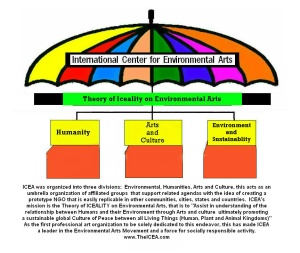
issues. ICEA was organized into three divisions: Environmental,
Humanities, Arts and Culture, this acts as an umbrella organization of
affiliated groups that support related agendas with the idea of creating
a prototype ICEA Affiliate Centers that are easily replicable in other
communities, cities, states and countries.
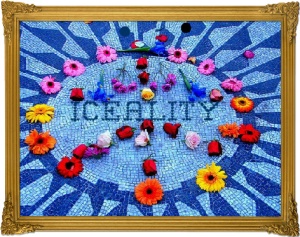
ICEA’s mission is the Theory of ICEALITY on Environmental
Arts, that is to “Assist in understanding of the relationship between
Humans and their Environment through Arts and culture ultimately
promoting a sustainable global Culture of Peace between all Living
Things (Human, Plant and Animal Kingdoms)”. As the first professional
organization to be solely dedicated to this endeavor, this has made ICEA
a leader in the Environmental Arts Movement and a force for socially
responsible activity. ICEA’s unique holistic approach for advocating
environmental issues through Iceality was enthusiastically accepted by
the United Nations and ICEA was invited to participate in the 1992 EARTH
SUMMIT in Rio de Janeiro.
David and Renate were on location in Canada
but Ben Chavis carried the artwork entitled ‘For the Children’ to the
earth Summit for exhibition. “The International Center for Environmental
Arts (ICEA) is the blueprint that all NGO organizations should aspire
to worldwide. Inspirational, groundbreaking, innovative, encouraging and
most important all inclusive. Creativity is strong in ICEA’s hands”.
Ben Chavis, UCC at the Earth Summit 1992.
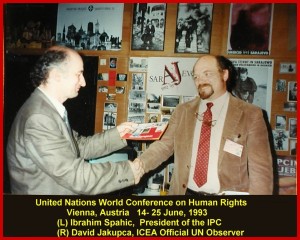
For the World Conference on Human Rights, 14-25 June 1993, Vienna,
Austria: Renate returned to her Heimatland as an Official United Nations
Observer to the World Conference on Human Rights. At the Conference on
Human Rights, Renate, with the approval of U.S. Delegates, Jimmy Carter
and Geraldine Ferraro, began recycling and promoting United Nations’
World
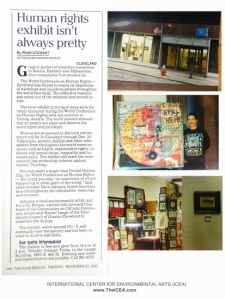
Conferences
through ICEA here in Cleveland. With this partnership with the United
Nations, ICEA has influenced a global audience of literally billions of
the Worlds Children. The Bosnian War in former Yugoslavia was going on
just south of Vienna during the Human Rights Conference.
The Neighbor in
Need Program was in effect at the Conference with members of the human
rights monitoring team which was composed of international
representatives assisting in organizing the largest private donor
initiative program in the Balkans. Over 42,000 tons of food and medicine
were carried by truck loads to 300,000 refugees and dislocated persons
(Muslims, Croats and Serbs). The relief deliveries and the distribution
were channeled through the Austrian Red Cross and Caritas and the truck
loads of goods was dispatched, and the Austrian people were personally
thanked by the Secretary General of the United Nations, Boutros
Boutros-Ghali. Working with the Neighbor in Need Program, Renate
realized that war affects the Worlds Children in different ways. First,
those children are dependent on the care, compassion, and attention of
family around them.
These family bonds are often disrupted in times of
war and refugee children may be forced to substitute care with strangers
or lose all adult protection. During the Bosnian War, they were known
as “unaccompanied children”. David Jakupca told me during our interview
that “…at the UN Conference on Human Rights – Revisited in Cleveland,
Ohio, Renate went immediately to the leaders of the Cleveland community
with Dr. Werner Lange, Director of the InterChurch Council of Cleveland
to organize a local Neighbor in Need Program for Bosnia. This
humanitarian action was eventually supported by US Ambassador Milton
Wolfe and reached the office of President Bill Clinton. Her lifetime of
work advocating for All the Worlds Children at ICEA has been providing
training and community networking opportunities for youth for almost 30
years while sponsoring environmental educational workshops, conferences,
and national and international exhibitions promoting the building of
multicultural diversity and greater global cooperation.
This has won her
critical acclaim from scores of international institutions and
countries including several from the United Nations, the Nelson Mandela
Peace Medal, the German Expolino Award, the Helen Prize and the Freedom
Award. Ambassador Renate, as the First Lady of Peace is a living marvel
as the worlds foremost campaigner for All the Worlds Children. During
her travels around the World with the United Nations Worlds Conference
Program Ambassador Renate has met many of the world’s most influential
people including Mr. and Mrs Nelson Mandela, Hillary Clinton, Fidel
Castro,
Yasser Arafat, Jane Fonda, Presidents and
Ambassadors from all 140 countries. Also, numerous leaders in business,
education, activist, entertainers and many more connected with the UN
Conferences.And that is just part of her story.

As
a life long champion against social injustice and defender of basic
rights Ambassador Renate garnered her share enemy’s. This became
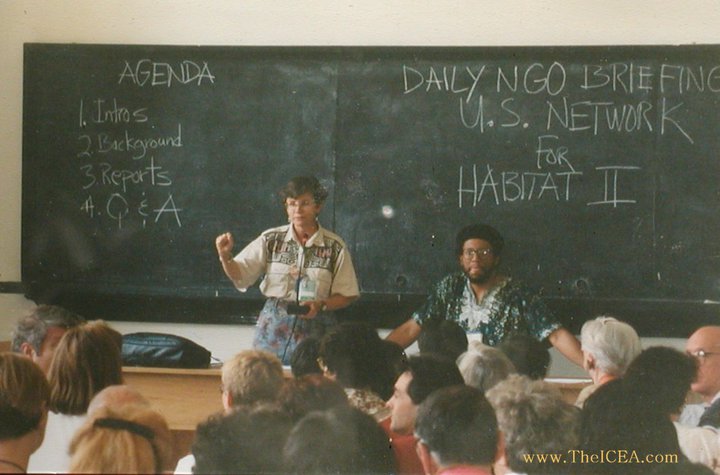
painfully apparent after HABITAT II. The Second United Nations Conference on Human Settlements HABITAT II was held in Istanbul, Turkey from June 3–14, 1996.
Renate recycled the UN Conference and it was packed up in Istanbul,
Turkey and sent safely to ICEA HQ’s in Cleveland, Ohio to be an official
part Cleveland’s Bicentennial Celebration: Ironically entitled “the
Spirit of Habitat II – What is a City but its People”, it was set up and
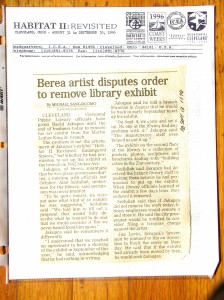
opened for a private showing but never opened to the public. Shysters
and charlatans masquerading as legitimate business and civic leaders
convinced the Cleveland Public Library to close it down immediately,
hoping to bankrupt and close ICEA. The Cleveland International Council
was formed to replace ICEA when that happened. Fortunately, others in
the community stepped forward and that did not happen. The exhibition
was taken apart and set up in various locations around the city and what
could not be used was sent to ahead to South Africa, the exhibitions
next destination. A detailed account can be found in the ‘The Internecine Matrix’.
- “Respect for human and environmental rights and greater
understanding between people from different racial and religious
backgrounds must be the first goal of society in today’s fast-changing,
globalized world.” This goal is accomplished “By focusing on the
creative process and affirming to the principles of the “Theory of Iceality on Environmental Arts”. Jakupca’s Theory on Environmental Arts (ICEALITY*) was enthusiastically embraced by the United Nations by 1990 and was featured in many of their World Conferences:
- 1- 1992 Earth Summit on the Environment, Rio de Janeiro, Brazil
- 2- 1993 World Conference on Human Rights, Vienna, Austria
- 3- 1994 World Conference on Population and Development, Cairo, Egypt
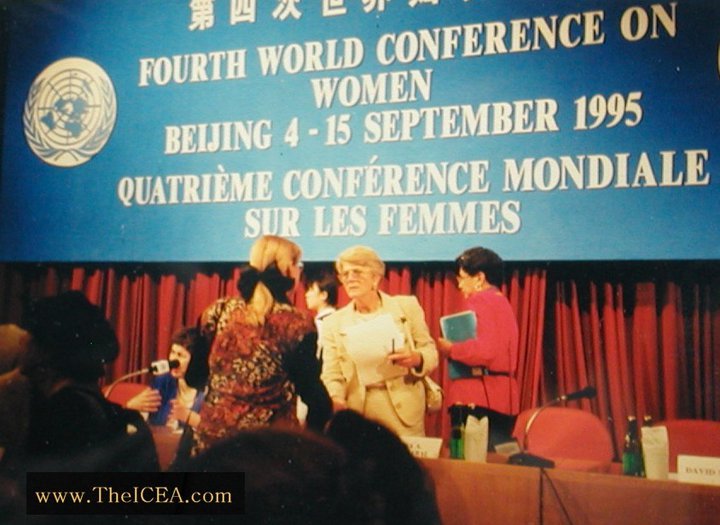
- 4- 1995 World Conference on Women, Beijing, China
- 5- 1996 Habitat II- UN Conference on Human Settlements, Istanbul, Turkey
- 6- 2000 World’s Fair, Expo2000, Hannover, Germany
- 7– 2001 World Conference on Racism, Durban, South Africa
- 8- 2002 World Summit on Sustainability, Johannesburg, South Africa
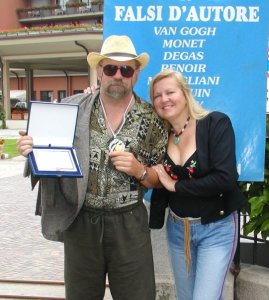
- 9- 2003 World Conference on Peace, Verbania, Italy
- 10- 2005 World Conference on Peace, Verbania, Italy
- 11- 2007 World Peace Conference, Santa Fe, New Mexico
“The World Conferences-Revisited Program will, in all its work,
endeavor to speak out clearly in favor of local, regional and global
long-term interests that allow basic problems to be addressed. It will
seek always in its work, to promote the interests of the poor,
underprivileged and disenfranchised, and show to future generations that
multicultural development is an essential ingredient for sustainable
development” says Ambassador Renate.

The result of this major global public promotion at the United Nations
level is that the Theory of Iceality on Environmental Arts is now
considered as the cornerstone of the modern sustainable global
Environmental Art Movement and this concept is now replicated by
artists, architects, urban planners and sustainable organizations
throughout the World, reflecting a still growing global audience. To
Read More on Ambassador Renate’s United Nations Revisited Program
‘click here’
Growing up in Greater Cleveland and basing the International Center
for Environmental Arts (ICEA) there, she has received the recognition
and respect from elected officials there ever since Cleveland Mayor
George Voinovich presented the first one in 1982. Mr. Baba Brohi,
Pakistan Peace Emissary, founder of Pakistan World Peace Daily and
educator in the field of Iceality education supports Ambassador Renate
because she is totally committed to her vision and that acts as an
inspiration to young people everywhere to contribute to the peace
process by creating a nexus of young international leaders committed to
building a better future for themselves and all generations of the
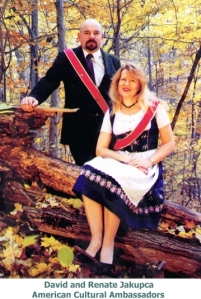
Worlds Children. On April 16, 1997, David and Renate Jakupca was
appointed by Herr Lukardis von Studinitz, Generalkommissiart EXPO2000,
as American Cultural Ambassadors to EXPO2000, the Worlds Fair held in
Hanover, Germany. This
project was named ‘The US
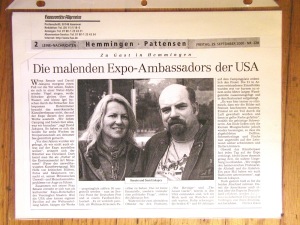
Network
for EXPO2000′ (www.expo2000usa.com ) and would be the first time the
internet would be used in conjunction with an overseas exhibition.
Because of the success of the ‘The US Network for EXPO2000′ project,
people from all over the world would use its internet data base to find
information on the Fair. Renate Jakupca would eventually spend six
month’s in Germany. As part of EXPO 2000’s ‘Culture on the Move’
segment. American Cultural Ambassadors David and Renate Jakupca
addressed the 140 Nation Assembly of the concept for a permanent
universal symbol of renewal and peace on earth for all living
inhabitants through the ‘Theory of Iceality on Environmental Arts’. This
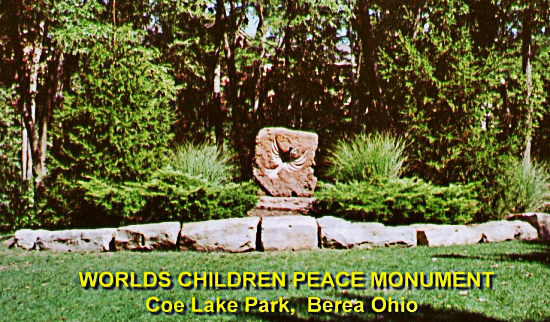
Universal Symbol of Living Peace was the
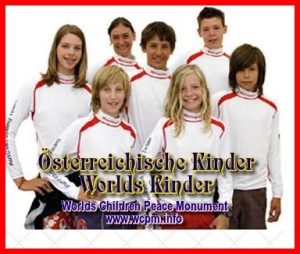
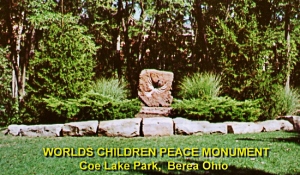
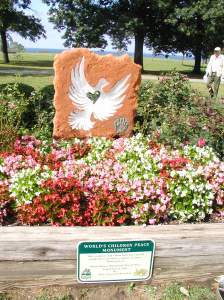
Worlds Children Peace Monument (WCPM).
This project was initiated in cooperation with the United Nations 2000
Culture of Peace Program and organized in support of the UN Decade of
Peace and Non-Violence for the Children of the World and the United
Nations Millennium Development Goals. At the closing of EXPO2000 in
October 2000 she was instructed that this not the end of her work as
Ambassador but just the just the beginning as its representative on the
impact of the future of Mankind.
However,
Ambassador Renate’s humanitarian actions are even more spirited than
her words here is a partial list of international projects she has
piloted:
• ‘People not Mascots’ Logo
– The ‘People Not Mascots’ Logo is meant to be a Native American
protest caricature of the racists Chief Wahoo logo of the Cleveland
Indians Baseball team. The “People not Mascots’ Logo gained
international popular attention when it was it exhibited by ICEA at the
1993 UN World Conference on Human Rights held in Vienna, Austria and has
become one of the most recognized anti-racists logo’s in existence
changing the way people worldwide view the trillion dollar sports
industry.
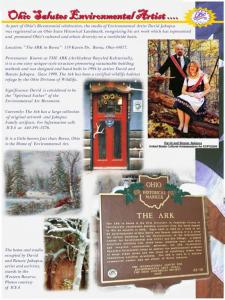
• ARK in Berea –
The historic A.R.K. in Berea is the first structure in Cuyahoga County,
Ohio to incorporate sustainable building concepts from the Earth Summit
in Rio de Janeiro in 1992. Hand built in 1994 as a work of art by
Environmental Artists David and Renate Jakupca. It is a practical design
study for the ‘Theory of Iceality in Environmental Arts’ for future
buildings and for the global headquarters of the International Center
for Environmental Arts (ICEA) and Cleveland’s Eco Village.
It is also a pioneer structure for the Leadership in Energy and
Environmental Design (LEED) Certification developed by the U.S. Green
Building Council (USGBC) in 1998. The A.R.K. is hybrid structure
utilizing cob, straw bales, aluminum cans, used tires, and recycled
construction materials, It helped to address the environmental problems
through ‘iceality’ of large urban areas and the trend of remodeling
rather than demolishing and rebuilding existing structures. The ARK in
Berea is used as an eco-museum, community center, and art studio of
American Cultural Ambassadors David and Renate Jakupca. It is recognized
as the ‘Birthplace of the sustainable Environmental Art Movement and is
registered with the Berea Historical Society, Western Reserve
Historical Society and the Ohio Historical Society.
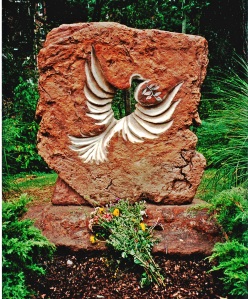
• Worlds Children Peace Monument (WCPM) –
The concept of a permanent universal symbol of renewal and living peace
for all living things was conceived at EXPO200. It was organized in
support of the UN Decade of Peace and Non-Violence for the Children of
the World and the United Nations Millennium Development Goals. The
incorporation of the rights of flora and fauna in a “Universal Peace
Equation” is the first major change in achieving a sustainable global
Culture Peace on Earth in over 2000 Years •“Theory of Iceality on Environmental Arts” is
The Science behind Peace and Global Harmony. Developed in 1987, it is
the practical study on the aesthetics of the relationship between
Humans and their Environment through Arts and Culture, ultimately
promoting an effective sustainable global Culture of Peace between all
Living Things ~ Human, Plant and Wildlife Kingdoms! The
incorporation of the rights of flora and fauna in a “Universal Peace
Equation” is the first major change in achieving a sustainable global
Culture Peace on Earth in over 2000 Years.
•The “Iceality Methodology”
– is the the most powerful tool in the history of Social Activism……on
Facebook! Utilizing the 1987 “Theory of Iceality on Environmental Arts”,
the ‘Iceality Methodology’ was developed at EXPO2000 the Worlds Fair
held in Hanover Germany to promote the building of the Worlds Children
Peace Monument (WCPM) and the Great American Peace Trail. Originally
designed for MYSPACE, The ‘Iceality Methodology’ has been ‘borrowed’ as a
tool for social change by virtually every social activist organization
and group on Facebook and is used by over 3 Billion people in a still
growing audience.
• Building the National Coast-to-Coast ‘Great American Peace Trail’ –
The “Worlds Children Peace Monument” (WCPM) and the “Great American
Peace Trail” (GAPT) Projects are international, public participatory art
projects designed to engage children with cross-cultural awareness in
order to attain the common goal of sharing peace and diversity with
their neighbors.
•The Department of Peacebuilding
– Democrats of the Congessional Black Caucus are using the Theory of
Iceality on Environmental Arts as a model for a proposed a new federal
agency

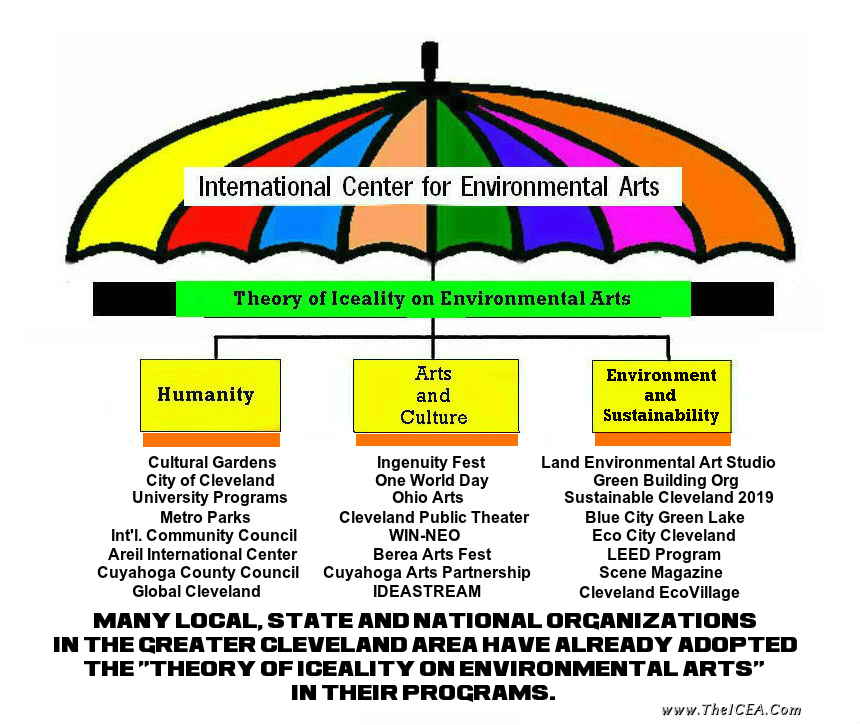
A
partial list of Local, State, and National in the Greater Cleveland
Area that have adapted the ‘Theory of Iceality on Environmental Arts” in
their program.
 SERVICE WITHOUT PROFIT or GLORY:
 In their
2012 Iceality Silver Revelation,
the Jakupca’s called for the Greater Cleveland area to come together to
design and create the comprehensive system changes to heal this planet
and humanity. In this respect, Renate and David are to be considered a
philosophical influence behind the dawning of the millennium’s
Sustainable Age. In their works, the Jakupca’s called for a development
of their avant-garde trilateral symmetry of social systems to align this
vision with real-world social conditions and logistics that contend
with the problems facing earth’s future. Recalling Einstein’s
admonition, paraphrased here, that a problem cannot be solved by the
same thinking that created the problem in the first place. The
Jakupca’s, being ever mindful of the ecospheric integrity, advocated
that the Iceality on Environmental Arts should be practical and have as a
holistic purpose the improvement of all living things and ending
ecocide. They always proposed that to accelerate the core building
blocks of society, all environment/scientific/artistic work should be
done in conjunction for charitable purposes – ‘service without profit
or glory’, so they never put financial restrictions on their work.
Renate is an indispensable mentor for tomorrow’s young leaders – as you
can see she also performs an invaluable function with today’s political,
civic, environmental, cultural, religious and other devoted
advocates…..all the Worlds Children have found a common meeting ground
in Iceality with Ambassador Renate’s generous assistance.
.

The Science behind Peace and Global Harmony should be practical and
have as a universal primary purpose the designing of useful things for
the improvement of All the Worlds Children. This changed the course of
Art in history, from a merely contemplative state, as it was found in
ancient times, to a practical, inventive modern state – and this will,
it time, continue to lead to the new ‘Methods of Iceality’ that will
make possible the Sustainable Age, a Culture of Peace for all Living
Things in the following centuries.
by Eugene Schiopota
~~~~~~~~~~~~~~~~~ MORE ~~~~~~~~~~~~~~~~
Continue reading →







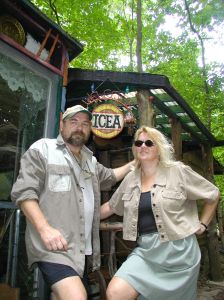


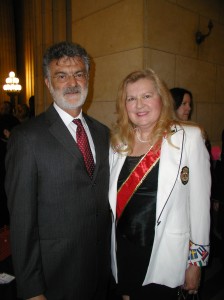
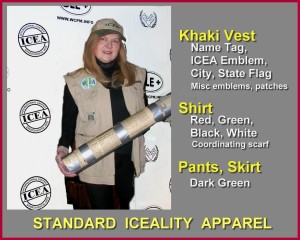
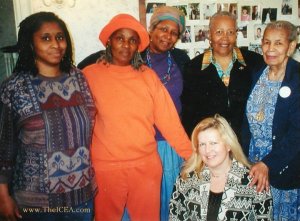











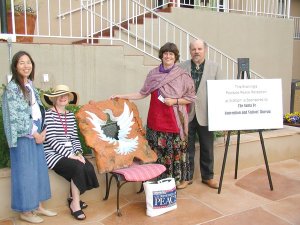

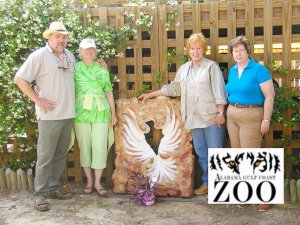

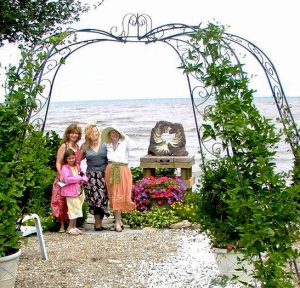

















 Hi
Everyone! Been away from Facebook for a while working in the real
world. The last week of weather was spent making a plans for new garden
before the Memorial Day dedication celebration. I managed to take a couple of pics
with Ms Iceality who is wearing my famous Sindhi Ajrak scarve, a gift
from Pakistan Peace Emissary Dr Abdul Jabbar Brohi.
Hi
Everyone! Been away from Facebook for a while working in the real
world. The last week of weather was spent making a plans for new garden
before the Memorial Day dedication celebration. I managed to take a couple of pics
with Ms Iceality who is wearing my famous Sindhi Ajrak scarve, a gift
from Pakistan Peace Emissary Dr Abdul Jabbar Brohi.